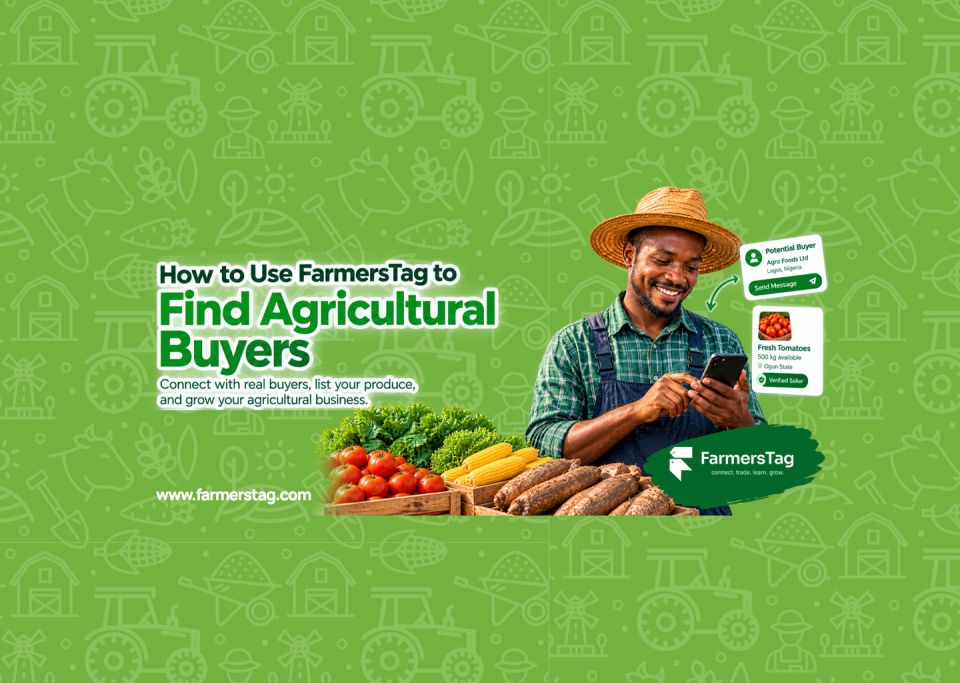
Finding a buyer shouldn't begin when your produce is already ready for harvest. One of the advantages of using a platform built specifically for agriculture is that you can start making connections before you need to sell.
FarmersTag gives farmers a dedicated place to make their agricultural activities, products and interests more discoverable.
Instead of depending entirely on scattered WhatsApp groups, social media posts and personal contacts, farmers can use FarmersTag to:
Discover agricultural businesses and potential buyers
List farm produce and agricultural products
Connect with other farmers
Join commodity-specific communities
Find businesses involved in processing, trading and distribution
Discover agricultural opportunities
Research agricultural products and services
Build an agricultural profile and identity
1. List Your Produce on the FarmersTag Marketplace
If you have produce available for sale, one of the simplest things you can do is make it visible.
For example, instead of simply telling people:
"I have maize for sale."
A stronger listing could provide:
Yellow Maize for Sale
Quantity: 10 tonnes
Location: Abeokuta, Ogun State
Condition: Clean and properly dried
Packaging: 100kg bags
Availability: Ready for pickup
Suitable for: Feed production and grain trading
The more useful information you provide, the easier it becomes for a potential buyer to decide whether your produce fits their requirements.
You can use the FarmersTag Marketplace to make your products discoverable.
2. Make Your Farmer Profile Work for You
A marketplace listing tells people what you are selling. Your profile can tell them who you are.
A farmer or agricultural business profile can become a place to show:
What you farm or sell
Where you operate
Your agricultural interests
Your experience
Products you regularly supply
Your business information
Other relevant agricultural activities
This matters because buyers may be more comfortable dealing with someone whose agricultural identity and activities they can understand.
The goal is to move beyond:
"Someone selling tomatoes."
to:
"A tomato farmer in Ogun State who regularly produces and supplies tomatoes."
That distinction becomes more important when you're trying to build repeat business.
3. Join Relevant Agricultural Communities
FarmersTag Communities can also help you find people operating within your commodity or geographical area.
For example, a fish farmer could participate in a fish farming community, while a cassava farmer could join a cassava-focused community.
Explore FarmersTag Communities
These communities can be useful for:
Sharing what you produce
Asking where buyers are sourcing from
Connecting with other farmers
Finding aggregation opportunities
Learning about market requirements
Discussing prices and production challenges
Building relationships with people in the same value chain
For example, imagine five maize farmers in the same community each have 2 tonnes available.
Individually:
Farmer A: 2 tonnes
Farmer B: 2 tonnes
Farmer C: 2 tonnes
Farmer D: 2 tonnes
Farmer E: 2 tonnes
Together, they have 10 tonnes.
That could make them more attractive to a buyer looking for a larger volume than any individual farmer can supply.
4. Search for the Businesses Behind the Market
Don't think only about "farm produce buyers."
Think about who needs your product as part of their business.
If you produce:
Maize: look for feed manufacturers, grain traders, poultry businesses and aggregators.
Cassava: look for processors, garri producers, starch businesses and traders.
Catfish: look for restaurants, hotels, fish sellers, processors and consumers.
Eggs: look for bakeries, restaurants, food vendors, retailers and households.
Vegetables: look for restaurants, caterers, supermarkets, retailers and consumers.
Soybeans: look for feed manufacturers, processors and commodity traders.
FarmersTag can become particularly useful here because the platform is designed around the agricultural ecosystem rather than general social networking.
5. Don't Just Post "Available for Sale"
A common mistake is making a post like:
MAIZE FOR SALE. DM ME.
It gives a potential buyer very little information.
Instead, make your post useful:
10 Tonnes of Yellow Maize Available
📍 Location: Abeokuta, Ogun State
📦 Quantity: 10 tonnes
🌽 Product: Yellow maize
✅ Condition: Clean and properly dried
📅 Availability: Ready for pickup
🚚 Delivery: Available by arrangement
🤝 Bulk buyers welcomeSend me a message if you are currently buying maize or require additional information.
Now a potential buyer can immediately determine whether the offer is relevant.
6. Use FarmersTag Alongside Your Existing Channels
FarmersTag shouldn't necessarily replace WhatsApp, Facebook, personal relationships or farmer associations.
Use them together.
For example:
FarmersTag: Create your product listing and agricultural profile.
↓
WhatsApp: Share your FarmersTag listing with existing contacts and groups.
↓
Communities: Connect with farmers and agricultural businesses in your commodity.
↓
Offline relationships: Meet buyers, processors and aggregators directly.
↓
Repeat business: Keep your profile and listings updated as your supply changes.
This creates a much stronger system than posting the same product repeatedly in random groups.
7. Start Building Your Buyer Network Before Harvest
You don't have to wait until your produce is ready.
Suppose you are planning to harvest 20 tonnes of maize in three months.
Instead of waiting until harvest day, you can start using FarmersTag to:
Identify businesses involved in maize.
Join relevant communities.
Learn what buyers are looking for.
Connect with potential buyers.
Understand their preferred quantity and quality.
Build relationships.
Update your listing when the produce becomes available.
Then your harvest doesn't arrive with the question:
"Who will buy this?"
You already have people to contact.
8. Use FarmersTag to Build a Reputation, Not Just Sell Once
The long-term value is bigger than a single marketplace listing.
As you continue using FarmersTag, your agricultural presence can become an asset.
You can share:
Farming activities
Harvest updates
Products
Farm improvements
Agricultural knowledge
Experiences
Community participation
New products available for sale
Over time, someone looking for a particular agricultural product may discover your profile and see that you are actually active in that area.
That is more valuable than simply posting a classified advertisement.
A Simple FarmersTag Buyer-Finding Process
A farmer can follow this simple process:
1. Identify what you sell
What commodity or agricultural product do you have?
2. Create or update your profile
Make it clear what you do and where you operate.
3. List your product
Include quantity, location, quality, availability and other relevant information.
4. Join relevant communities
Participate in communities around your commodity, location or agricultural interest.
5. Connect with potential buyers
Look for businesses and individuals who may actually need your product.
6. Share useful information
Don't spam communities. Provide useful, relevant information about what you have available.
7. Build relationships
A buyer who purchases from you once could become a repeat customer.
8. Keep your information updated
When your stock changes, update your listing.
FarmersTag Is More Than Another Place to Advertise
The objective isn't simply to give farmers another website where they can post:
"Farm produce for sale."
The bigger opportunity is to make the farmer discoverable within an agricultural ecosystem.
Your farm can have an identity.
Your products can have visibility.
Your agricultural interests can connect you with relevant communities.
And your marketplace listings can make what you have available easier for potential buyers to discover.
That is where FarmersTag fits into the buyer-finding problem.
Produce it. List it. Connect with the right people. Build relationships. Grow your agricultural network.
Your next buyer may already be looking for what you produce. The first step is making it easier for them to find you.